Why this niche matters more than most people realize
Landlord-tenant disputes look "small" from the outside, but in reality they are often high-pressure and time-sensitive. A missed deadline, an unclear notice, or incomplete evidence can shift leverage quickly. Most renters don't fail because they have zero facts. They fail because their facts are messy, emotional, and hard to process. That is exactly where legal-tech can help - not by replacing legal counsel, but by improving structure, speed, and clarity.
In practical terms, tools should help you do four things better: organize facts, draft clean communication, identify risk boundaries, and decide when escalation is needed. If a tool can't improve at least one of those outcomes, it is noise, not leverage.
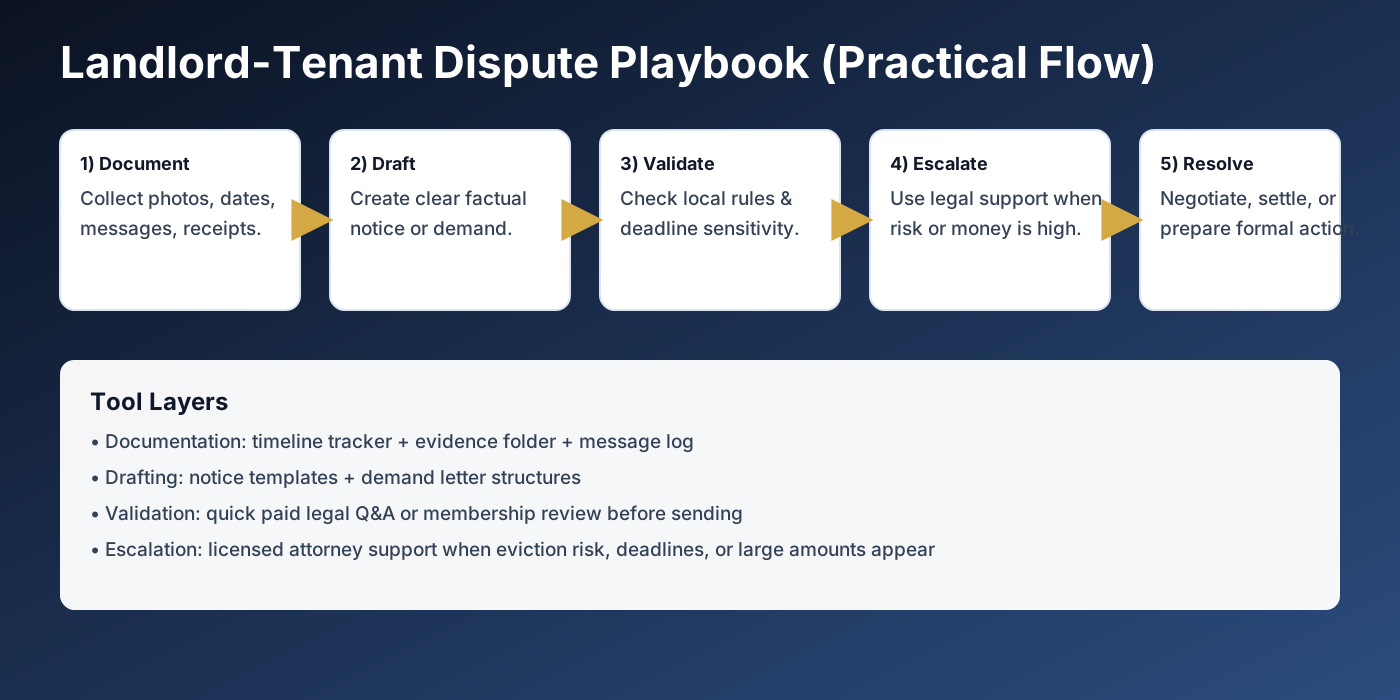
Figure 1 - A practical workflow for using legal-tech tools before and during landlord-tenant dispute escalation.
The 5-stage workflow that actually works
1) Document
Start with evidence, not argument. Build one timeline with timestamps, photos, receipts, and message history. Keep evidence centralized so every follow-up is consistent.
2) Draft
Use tools to generate a clear factual notice or demand letter. Keep tone calm. State what happened, what you want fixed, and by when.
3) Validate
Before sending, verify jurisdiction-specific rules (notice periods, required wording, procedural differences). This is where quick legal Q&A or membership support can prevent avoidable mistakes.
4) Escalate
Escalate early when risk is high: eviction exposure, statutory deadlines, retaliation concerns, or large financial impact.
5) Resolve
Aim for documented resolution first. If informal resolution fails, transition to a formal path with a stronger record.
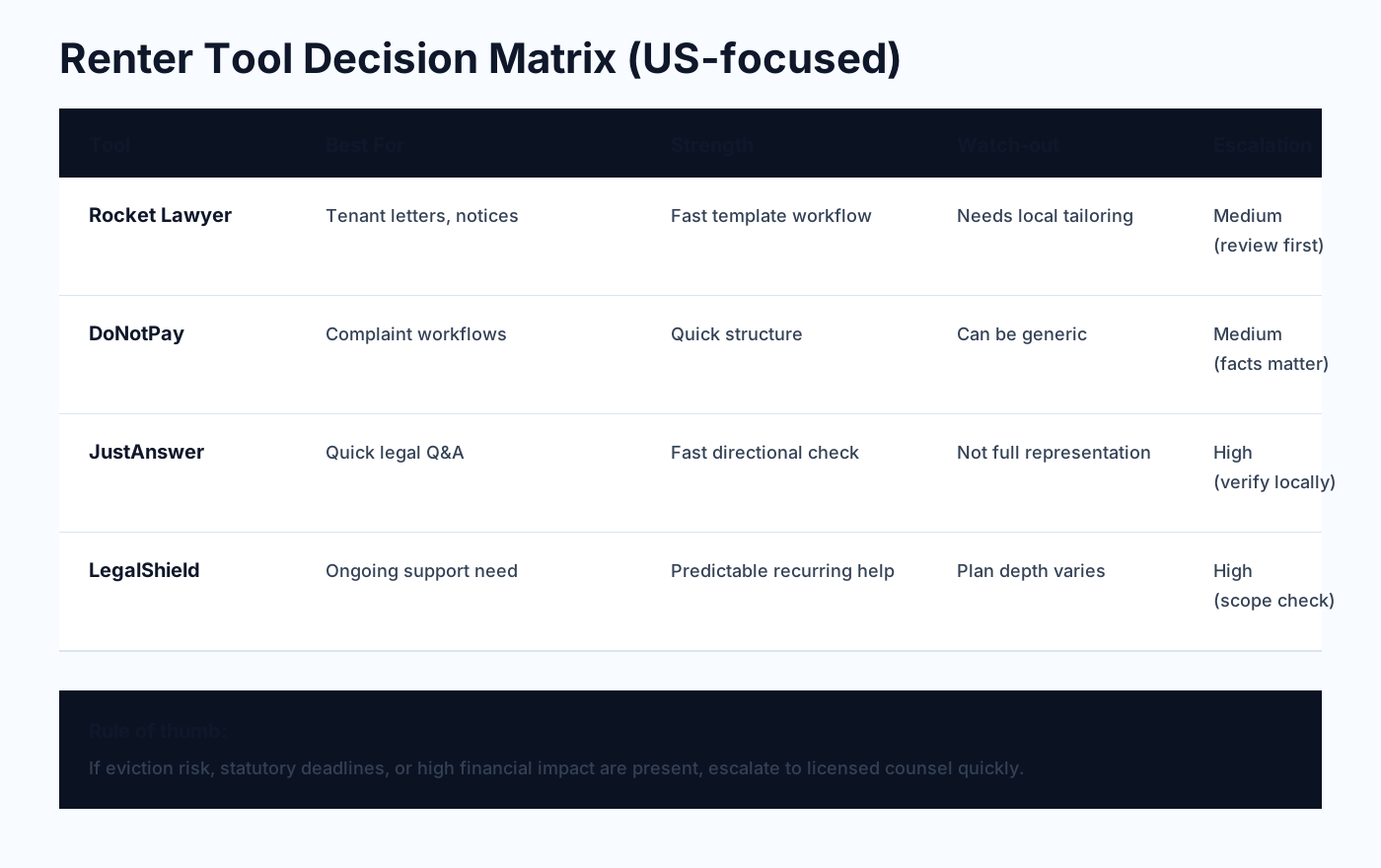
Figure 2 - Tool decision matrix for renter-focused legal workflows.
Tool-by-tool: where each one fits
Rocket Lawyer is strong when you need structure fast: notices, letters, and document templates. It works best for drafting consistency. It is weaker if you rely on templates without adapting to local legal detail.
DoNotPay can accelerate repetitive complaint workflows and provide a usable starting point. It is useful for momentum and formatting. It is not a substitute for validating legal assumptions.
JustAnswer can provide directional clarity when you are uncertain about next steps. Good for fast friction removal. Not a full representation model.
LegalShield is often better for ongoing legal friction than one-off questions, especially where repeated review or communication support is needed. Plan scope should always be checked before relying on it in high-stakes moments.
Best results usually come from combining these tools rather than choosing one "magic" option.
Common mistakes that reduce your success rate
- Emotional drafting: strong language with weak evidence loses leverage.
- Fragmented records: scattered screenshots and notes reduce credibility.
- Late escalation: waiting too long after deadlines or formal notices.
- Template over-trust: using generic text without local adaptation.
Long-term quality in this niche comes from process discipline, not from collecting more apps.
Implementation blueprint (first 7 days)
- Day 1: Build one clean timeline and evidence folder.
- Day 2: Draft initial notice using template tools.
- Day 3: Validate legal assumptions and deadline logic.
- Day 4: Send documented communication with clear requested remedy.
- Day 5-6: Track responses and maintain one consolidated record.
- Day 7: Decide: resolve, negotiate, or escalate to counsel.
This model keeps momentum while reducing unforced errors.
As a practical benchmark, if your timeline is complete, your notice is specific, and your escalation threshold is pre-defined, you are already ahead of most ad-hoc dispute handling approaches. That quality baseline is often enough to improve both speed and outcome reliability. This is exactly how disciplined renters turn messy disputes into structured, winnable processes.
Market map: renter disputes need task-specific tools, not generic stacks
In landlord-tenant disputes, most people do not lose because they have "no tools." They lose because they use the wrong tool at the wrong stage. A practical stack should improve at least one of these: evidence quality, communication quality, or escalation quality.
Case snapshot: A renter with a deposit dispute used one template app, sent two emotional emails, and waited three weeks to escalate. Another renter with a similar dispute used a timeline + evidence folder, one structured notice, and a quick legal validation pass before sending. Same issue category, very different execution quality.
Concrete tool mapping by task
- Drafting notices and letters: Rocket Lawyer → for structured templates and faster output quality.
- Complaint workflow acceleration: DoNotPay → for workflow momentum in early-stage disputes.
- Quick legal sanity check: AI Lawyer → for directional Q&A before you finalize communication.
- Recurring support model: LegalShield → when legal friction is recurring, not one-off.
- Professional crossover path: Clio (pro route) → when dispute handling becomes operational/legal-team work.
The winning pattern is simple: sequence your stack. Start with documentation, move to drafting, validate risk, then escalate when exposure increases. Tools should reduce procedural errors, not add busywork.
Deep workflow: from first issue to formal escalation
Phase A — Evidence architecture
Before you write a single letter, build your evidence architecture. That means one timeline, one source-of-truth folder, and one naming convention. For example: 2026-03-02_leak-kitchen_photo1.jpg or 2026-03-04_notice-email_landlord.pdf. It sounds small, but this determines whether your case looks credible later.
At this stage, tools are supportive but not central. Your first objective is factual integrity. Capture what happened, when it happened, what you requested, and what response you received. If repair issues are involved, include repeated notice attempts and any health/safety implications with dates.
Phase B — Communication drafting
Now use template-oriented tools to create structured communication. Good drafting has four parts: factual summary, requested remedy, deadline, and escalation statement. Avoid legal theater language. Credibility beats aggression in early-stage disputes.
Tools like Rocket Lawyer and similar template platforms help with structure. But structure is not the same as legal correctness. Treat templates as scaffolding, not final legal truth. If the jurisdiction has specific wording requirements, adapt accordingly.
Phase C — Validation and risk check
This is where many users skip steps and lose leverage. Before sending final notice, run a quick validation pass. Ask: Are deadlines compliant? Is the remedy realistic? Are there tenant obligations in the lease that could weaken your position?
Quick legal Q&A tools can be useful for directional checks. Membership models can help if you expect repeated touchpoints. But if eviction signals or high financial exposure appear, move from “tool-first” to “counsel-first.”
Phase D — Escalation decision
You should escalate early when downside grows faster than your certainty. Signals include formal eviction notices, unreturned security deposits above meaningful thresholds, retaliation concerns, and hard statutory windows. Once those appear, software should support your file quality, while a licensed attorney leads strategy.
The decision is not emotional. It is risk-weighted. If legal downside multiplied by uncertainty exceeds your tolerance, escalate.
Tool stack by renter profile
Profile 1: First-time renter with documentation gap
Goal: create order quickly. Start with one template tool + one checklist workflow. Keep costs low. Do not oversubscribe. Internal next step: consumer tool shortlist.
Profile 2: Repeat dispute history with landlord
Goal: consistency over time. You likely need recurring legal support and better records discipline. Membership-style support may outperform one-off advice because disputes are iterative, not single events.
Profile 3: High-value tenancy or business impact
Goal: reduce downside. Move faster to professional review. Use software for file quality and timeline clarity, but shift strategic decisions to counsel. Helpful crossover path: professional mode in Tool Finder.
Profile 4: Time-constrained renter under deadline pressure
Goal: prioritize sequence. Do not try to perfect everything. Do this: gather critical evidence, send one clean notice, validate deadline logic, and decide escalation. A shorter complete process beats a perfect unfinished one.
When in doubt, optimize for documented clarity and time discipline. Those two factors consistently outperform “smart wording” alone.
Comparison lens: speed vs legal certainty vs cost
Every renter tool choice is a trade-off among three constraints:
- Speed: how fast you can draft and send compliant communication
- Legal certainty: how confident you are that wording/process aligns to local requirements
- Cost: direct subscription/consult spend plus hidden error cost
If you push too hard on speed, certainty drops. If you push too hard on certainty without urgency, deadlines can pass. If you push too hard on cost reduction, error risk rises. High-quality execution balances all three intentionally.
A practical model is:
- Use software to get from zero to structured draft quickly.
- Use validation support to reduce legal process errors.
- Escalate to attorney support when expected downside justifies it.
This is why mixed stacks outperform single-tool dependence in real disputes.
Longread appendix: practical templates and checklists
A) Notice quality checklist
- Clear issue statement (what happened)
- Date/time anchors
- Reference to prior communication attempts
- Requested remedy in plain language
- Specific response deadline
- Neutral tone, no personal attacks
B) Evidence packet checklist
- Lease snapshot (relevant sections only)
- Photo/video evidence with date context
- Message/email thread exports
- Receipts and maintenance logs
- Chronological event timeline
C) Escalation trigger checklist
- Formal eviction notice received
- Statutory response deadline approaching
- Large financial exposure (deposit/rent/penalties)
- Potential retaliation indicators
- Cross-issue complexity (multiple legal themes at once)
These checklists are simple by design. Under stress, simple systems are more likely to be used correctly.
Execution paths: what to read next based on your real situation
If you only read one more page, choose based on your bottleneck, not curiosity. This prevents "research loops" and gets you to better decisions faster.
If your problem is clause risk
Start with Lease Review category guidance →. Use this when you need to understand whether lease language itself is creating downside (fees, renewal traps, obligations, notice mechanics).
If your problem is tool selection speed
Go to Consumer Tool Finder →. Filter by use case first, then by pricing structure. Do not compare 20 tools at once; shortlist 2-3 and test against your workflow checklist.
If your problem is vendor confidence
Read deeper reviews before committing: Rocket Lawyer review →, AI Lawyer review →, and, if your path shifts to operational/legal-team handling, Clio review →.
If your problem is full implementation strategy
Use the Ultimate Legal Tech Stack Guide → for rollout sequencing, governance checkpoints, and tool-layer integration logic.
The objective is not more tabs. The objective is better execution per step, with less ambiguity and fewer procedural errors.
Scenario deep-dive 1: security deposit dispute workflow
Security deposit conflicts are among the most common and most emotionally charged renter disputes. The technical challenge is rarely “what happened.” The challenge is proving sequence, reasonableness, and communication quality under time pressure. Start with itemized facts: move-out date, condition evidence, inspection records, and all post-move correspondence.
Use software for three concrete outputs: (1) a clean chronology, (2) a structured demand notice, and (3) an escalation packet. The chronology should include each request and response. The demand notice should state amount disputed, basis for dispute, and requested action by a specific date. The escalation packet should hold all attachments in one place.
Action block (15 minutes)
- Write one timeline with date + event + proof.
- Draft one clear deposit demand with exact amount and deadline.
- Prepare one escalation folder with all attachments.
Mini-case: Fout: renter sent three emotional emails with no evidence index. Correctie: one structured notice + timestamped evidence folder. Resultaat: faster substantive response and improved settlement position.
When should you escalate? Escalate when the amount is meaningful relative to your risk tolerance, when the opposing response is non-substantive, or when legal deadlines approach. If you need a quick path comparison, open consumer tools and compare dispute-oriented options.
Scenario deep-dive 2: repair and habitability conflicts
Repair disputes can deteriorate quickly because they blend legal duties, safety concerns, and communication breakdowns. The right workflow begins with objective logging: what condition exists, when it was reported, what follow-up occurred, and what impact it caused. Avoid vague language like “this has been bad for weeks.” Use dated, specific statements with evidence references.
In this scenario, software is best used as a case-file amplifier. Draft one formal request, one reminder, and one final escalation notice with consistent language. Consistency matters because contradictory wording across messages can weaken your position. Template reuse with factual edits is usually better than drafting from scratch each time.
Action block (15 minutes)
- Document issue severity with dated photos.
- Send one formal repair request with explicit deadline.
- Set escalation reminder before statutory window closes.
Mini-case: Fout: tenant sent inconsistent messages across channels. Correctie: one template-driven notice sequence with consistent wording. Resultaat: clearer negotiation track and stronger escalation readiness.
Jurisdiction sensitivity is high here. Notice requirements, landlord duties, and tenant remedies vary. This is where validation support is essential before sending final notice. For broader lease-risk context, cross-check with Lease Review guidance. If the issue touches business tenancy or professional operations, compare professional tools as well.
Escalation threshold: if health/safety risk is material, if response windows are repeatedly missed, or if legal deadlines are close, move from tool-only to counsel-supported strategy. Software should continue supporting record quality, but legal strategy should not remain fully automated under elevated risk.
Scenario deep-dive 3: lease clause ambiguity and fee disputes
Clause ambiguity disputes happen when lease language is broad enough to invite interpretation but specific enough to create financial impact. Typical examples include cleaning deductions, renewal fees, subletting restrictions, and late fee structures. In these cases, emotional certainty is a poor guide. Textual precision wins.
Your first task is comparison: clause text, factual event, requested action. Build a side-by-side note that isolates each point. Then generate communication that references exact language without overclaiming. Tools can accelerate this drafting, but overconfident interpretation is a risk. If you are uncertain about legal meaning, validate before sending final demands.
Action block (15 minutes)
- Create a side-by-side clause comparison sheet.
- Draft one focused notice per disputed clause.
- Flag high-impact ambiguity for fast legal validation.
Mini-case: Fout: renter challenged five clauses in one vague message. Correctie: split into clause-by-clause requests with exact references. Resultaat: landlord responded on substance, not tone, and dispute narrowed faster.
Document-oriented platforms are useful here because they standardize communication and reduce omission risk. For broader context on legal document stacks and drafting systems, see related reviews like Rocket Lawyer and category flows in Tool Finder. If this expands into repeated contract interpretation needs, consider a mixed stack including legal Q&A support.
Escalate when clause interpretation materially affects cost, tenancy continuity, or legal exposure. The earlier you escalate in high-impact ambiguity, the less rework you create later.
Operational quality: what “good” looks like in renter legal-tech execution
High-quality execution can be measured. Most renter workflows improve when you track three operational metrics: response cycle time, documentation completeness, and escalation readiness. Response cycle time is the gap between issue discovery and first formal communication. Documentation completeness is whether evidence, timeline, and correspondence are centralized. Escalation readiness is whether your file can be handed to counsel without rebuild.
If you improve these three metrics, outcomes usually improve regardless of tool brand. This is why we focus on process quality in addition to software features. A weak process using premium tools still underperforms. A strong process with moderate tools often performs surprisingly well.
In practice, define a weekly review ritual: update timeline, validate outstanding deadlines, and clean evidence folder naming. Then audit one communication sample for tone and specificity. These small habits compound quickly and reduce avoidable procedural mistakes.
If you run a multi-property or team-based environment, standardize this into a simple SOP. The same logic used in legal operations for firms applies at smaller scale for renter support workflows.
How to choose between one-time tools and recurring legal support
One-time tools are generally best for bounded tasks: one notice, one draft, one dispute packet. Recurring support models are generally better for repeated friction where legal interpretation and follow-up are ongoing. The decision should be based on dispute frequency and downside variability, not on marketing promises.
If your issue is isolated and low-risk, a one-time stack may be enough. If disputes recur or involve layered issues, recurring support can reduce decision fatigue and improve consistency. Many users end up in a hybrid model: templates for drafting, plus recurring access for validation.
Use this heuristic:
- Low frequency + low downside = one-time workflow tools
- Medium frequency + medium downside = hybrid workflow
- High frequency or high downside = recurring support + early escalation logic
This framework helps avoid overbuying software in low-risk contexts and under-supporting yourself in high-risk contexts.
Advanced implementation: building your own renter dispute dashboard
If you want professional-grade control, build a lightweight dashboard (spreadsheet or simple tool workspace) with five modules: issue log, evidence index, communication tracker, deadline tracker, and escalation decisions. This converts chaos into a system.
Issue log: each dispute item with status. Evidence index: file name + date + relevance tag. Communication tracker: outbound/inbound messages with timestamps. Deadline tracker: jurisdiction-specific due dates. Escalation decisions: rationale for when and why you moved to legal support.
Why this matters: when disputes evolve, memory fails. A dashboard prevents narrative drift and keeps your position coherent. It also makes legal handoff dramatically easier if counsel becomes necessary.
You do not need expensive software to implement this. Start with simple structure, then connect tools only where they remove specific friction points.
Underrated advantages that separate strong cases from weak ones
Most renters invest effort in writing better messages but underinvest in operational quality. In real disputes, operational quality often decides leverage.
Advantage 1 - Deadline control systems
Set reminders for notice deadlines, response windows, and escalation triggers. A missed date can collapse a strong factual position. Use simple scheduling tools if needed; consistency is more important than complexity.
Advantage 2 - Evidence indexing (not just evidence collecting)
Collecting screenshots is not enough. Indexing evidence with date + relevance labels makes your file usable under pressure. This can reduce legal handoff time dramatically.
Advantage 3 - Version-controlled communication templates
Keep one approved structure for first notice, follow-up notice, and escalation letter. That avoids contradictory phrasing and improves credibility.
Advantage 4 - Post-case performance review
After each dispute, run a short debrief:
- Where did timing break down?
- Which messages worked best?
- Was escalation too early, too late, or correctly timed?
- Which tool produced measurable value versus noise?
This creates compounding improvement. One case improves the next case.
If your profile evolves into recurring legal operations, use professional paths such as Clio in Tool Finder → and the Clio review → to borrow stronger workflow discipline.
Final strategic perspective: how to avoid thin-content thinking in legal-tech decisions
Thin decisions usually come from thin context. If you only compare pricing tables, you miss workflow fit. If you only compare features, you miss escalation logic. If you only compare branding, you miss risk boundaries. Serious outcomes require integrated evaluation.
This is why LegalToolGuide emphasizes layered guidance: category context, tool-level detail, and implementation strategy. Start broad in Tool Finder, narrow through category pages, validate through review detail, then apply with workflow discipline.
For renter disputes especially, your competitive edge is not legal jargon. It is process maturity: clean records, clear communication, and timely escalation. Software can accelerate that maturity when used intentionally.
If you are building your own playbook, keep this simple rule:
“Every tool in your stack should reduce ambiguity, delay, or procedural error. If it doesn’t, remove it.”
Jurisdiction reality: why location-specific checks are non-negotiable
Two renters with identical facts can face different outcomes because procedures differ by state and city. Notice windows, service methods, and remedy options are not universal. This is why generic “internet advice” fails at the exact point where legal precision matters most.
A practical workflow is to keep your core evidence and communication process stable, while localizing three variables: statutory deadlines, notice formatting requirements, and escalation channels. If your current tool does not make it easy to localize these variables, you should add a validation step before sending final communications.
To stay practical, do not overcomplicate this with legal research rabbit holes. Use quick validation support to confirm what matters: timing, wording, and filing path. Then continue execution. The objective is not to become a legal scholar; it is to reduce procedural risk while maintaining momentum.
This is also where internal navigation matters: start with Lease Review context, then compare options in Tool Finder, and finally sanity-check assumptions with relevant review pages.
Cost model: direct spend vs error cost
People often optimize the visible cost (subscriptions, one-time fees) and ignore the hidden cost of mistakes (delays, weak notices, procedural misses). In landlord-tenant conflicts, hidden error cost can be larger than tool spend. This is why a “cheapest possible stack” can become expensive later.
Use a simple cost model:
- Direct spend: software + validation + possible counsel touchpoints
- Error risk cost: expected downside of sending weak communication or missing timing
- Time cost: hours spent rebuilding files due to poor structure
If direct spend increases but error risk and time cost drop significantly, total decision quality improves. This is why hybrid stacks are often optimal in medium-risk cases.
For users with repeated issues, recurring support may outperform repeated one-off purchases because process continuity improves and cognitive load drops.
Case pattern examples (anonymized)
Case pattern A — deposit conflict resolved pre-escalation
A renter with strong move-out documentation used template drafting plus a short validation pass before sending final notice. The result was faster negotiated settlement without formal escalation. Key success factor: clean chronology and specific remedy request.
Case pattern B — repair issue escalated too late
A renter collected evidence but delayed escalation despite repeated deadline misses. By the time counsel reviewed the file, leverage had weakened due to timing and fragmented communication. Key lesson: escalation delay can erase the value of good evidence.
Case pattern C — repeated friction improved with recurring support
A renter facing multiple landlord issues moved from one-off tools to recurring support + SOP structure. Consistency improved, emotional drafting declined, and response quality increased. Key lesson: recurring friction requires operational continuity, not isolated bursts of effort.
These patterns are common and reinforce the same principle: process maturity beats tool novelty.
Extended FAQ: practical questions renters ask before choosing tools
Do I need multiple tools from day one?
No. Start with one drafting/documentation workflow and one validation path. Add complexity only when dispute frequency or risk level rises.
What if I cannot afford recurring legal support?
Prioritize structure and timing first: clean evidence, clear notice, and deadline discipline. Then use selective paid validation for critical steps where error cost is high.
Can AI-generated letters hurt my case?
They can if they are generic, inaccurate, or too aggressive. Always adapt output to your facts, jurisdiction, and objective. Treat AI output as draft material, not final legal truth.
When should I stop trying to resolve informally?
Stop when communication loops repeat without substance, when legal deadlines approach, or when financial downside becomes material. At that point, escalation is usually more efficient than repeated informal messages.
Which internal pages should I use next?
Use Tool Finder for comparison, Lease Review category for contract context, and targeted reviews such as Rocket Lawyer and AI Lawyer for deeper vendor fit checks.
How do I know this workflow is working?
Track cycle time, completeness of documentation, and escalation readiness. If these improve month-over-month, your dispute execution quality is improving even before outcomes are fully visible.
Most importantly: consistency compounds. Repeating a good process beats improvising a perfect one under pressure.
Operator checklist: quality controls before you press send
Before sending any formal message, run this quick operator checklist:
- Does the message reference exact dates and specific facts?
- Is the requested remedy realistic and measurable?
- Is the response deadline explicit?
- Are attachments complete and clearly labeled?
- Would a third party understand this file in under five minutes?
If any answer is no, revise before sending. This five-minute gate prevents most avoidable quality errors and improves legal communication outcomes across almost every renter dispute type.
FREE UPDATES
Get practical legal-tech updates (max 2 emails/month)
Receive new tool picks, category updates, and implementation tips. No spam. Unsubscribe anytime.
Educational content only. Not legal advice.
Final take
Legal-tech can materially improve renter outcomes when used as a process amplifier: better evidence, better drafting, better timing, better escalation choices. The goal is not "AI replaces legal work." The goal is faster, cleaner decision quality before stakes rise.
This content is for educational purposes only and does not constitute legal advice. Always consult a qualified attorney for legal matters.